Predator-Proofing Your Chicken Coop and Run: How to Keep Your Flock Safe
Predator-Proofing Your Chicken Coop and Run: How to Keep Your Flock Safe
Keeping chickens can be incredibly rewarding, but providing food, water and a comfortable coop is only part of responsible chicken keeping. You also need to protect your flock from predators.
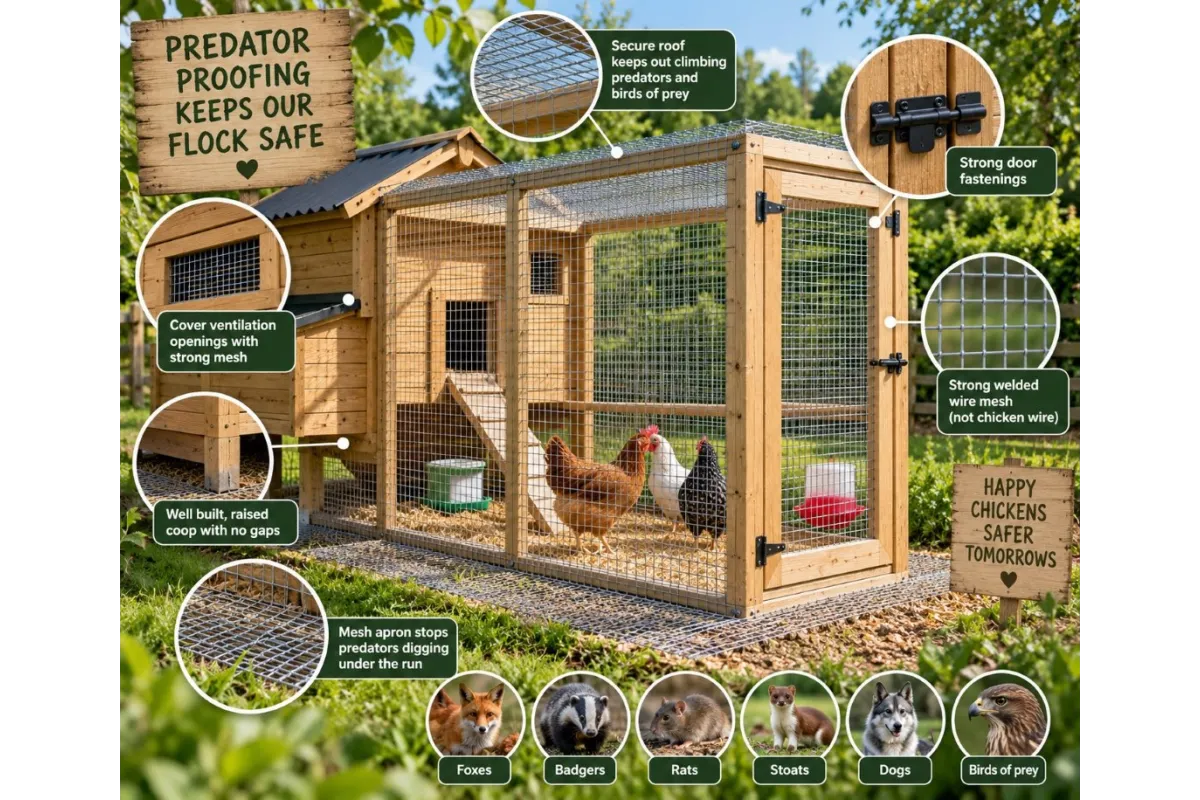
Chickens are vulnerable animals, particularly at night when they're sleeping. Foxes are perhaps the predator chicken keepers worry about most in the UK, but depending on where you live, other threats can include rats, mink, stoats and birds of prey. Even domestic dogs can cause devastating damage if they gain access to a chicken run.
The good news is that a carefully designed predator-proof chicken coop and run can dramatically reduce the risk.
Start With a Strong Chicken Coop
Your chicken coop is your flock's main line of defence overnight.
Inspect the entire structure regularly. Look for loose boards, damaged panels, gaps around doors and weak areas that could potentially be enlarged by a determined predator.
Pay particular attention to the floor and corners of wooden coops, especially older ones.
Doors should close securely and ideally have strong catches that can't simply be pushed or knocked open.
Don't forget the nest box. External nest-box lids should fit securely and have suitable fastenings if necessary.
Choose Strong Wire Mesh
One of the biggest mistakes when constructing a chicken run is assuming that traditional chicken wire provides sufficient predator protection.
Chicken wire is primarily designed to keep chickens contained. It isn't necessarily strong enough to keep determined predators out.
For a secure run, consider using strong welded wire mesh with appropriately small openings.
Check the mesh regularly for:
-
Rust and corrosion.
-
Broken welds.
-
Loose fixings.
-
Bent sections.
-
Holes or enlarged openings.
Mesh should also be firmly attached to the run framework rather than simply held in place with a few lightweight staples.
Stop Predators Digging Under the Run
A secure fence is little use if a predator can simply dig underneath it.
Foxes are capable diggers and may investigate the bottom of a run looking for an easy route inside.
There are several ways to improve protection.
One option is to bury suitable mesh vertically into the ground around the run. Another popular solution is creating an outward-facing mesh apron around the perimeter.
An apron extends horizontally away from the bottom of the run. When a predator approaches the fence and begins digging at its base, it encounters the buried or securely pinned mesh.
Paving slabs around vulnerable edges can provide another physical barrier.
Whichever method you choose, regularly inspect the perimeter for evidence of digging.
Don't Forget the Roof
Predator-proofing doesn't stop at ground level.
A fully enclosed run provides considerably greater protection than an open-topped enclosure.
A secure mesh roof can help prevent climbing predators from gaining access and can also offer additional protection against birds of prey.
If you're using a solid or partially solid roof, it has another advantage: providing your chickens with protection from rain and helping keep part of the run dry.
Check roof panels and mesh after storms or high winds to make sure nothing has become loose.
Secure Every Door
The run door is often one of the weakest points in an otherwise secure enclosure.
Make sure it fits properly and doesn't leave large gaps around the frame.
Use a robust fastening system. A simple hook that can easily move or become dislodged may not provide enough protection.
It's also worth getting into the habit of checking the door every evening.
A perfectly predator-proof run isn't much use if somebody accidentally leaves the gate open!
Consider an Automatic Chicken Coop Door
An automatic chicken door can add another useful layer of protection.
These doors can be programmed to close at a particular time or, depending on the model, operate according to changing light levels.
They're particularly convenient during winter when chickens may go to roost before you've finished work or during summer when you don't necessarily want to get up at sunrise to let them out.
However, an automatic door shouldn't replace regular checks.
Make sure every chicken has gone inside before the door closes and periodically inspect the mechanism to ensure it's operating correctly.
Remove Food That Attracts Unwanted Visitors
Predator prevention isn't only about barriers.
Chicken feed can attract rats and other unwanted visitors, which can create additional problems around the coop.
Store chicken feed in secure containers and clean up significant spillages.
Avoid leaving unnecessary quantities of food scattered around overnight.
Keeping the area surrounding your chicken house tidy can also make it easier to spot evidence of unwanted visitors, including droppings, tracks, digging or damage.
Remember That Rats Can Use Tiny Gaps
Large predators aren't the only concern.
Rats can squeeze through surprisingly small spaces and may be attracted by readily available chicken feed.
Inspect around doors, ventilation openings, floors and corners.
Ventilation is essential inside a chicken coop, so don't simply block ventilation holes. Instead, cover vulnerable openings with suitable strong mesh that allows airflow while helping prevent unwanted access.
Think Like a Predator
One of the best ways to inspect your setup is to walk slowly around the entire chicken coop and run and imagine you're trying to get inside.
Look underneath.
Look above.
Pull gently at the mesh.
Check every corner.
Examine hinges and catches.
Look behind vegetation and around the base of the enclosure.
Could something dig underneath? Is there a gap beside a door? Could an animal climb onto a nearby shed, fence or branch and jump onto the run?
Problems are much easier to correct before a predator discovers them.
Lock Your Chickens Away Every Night
Even if your chickens have a secure run, getting them safely inside their coop at night provides another important protective barrier.
Chickens naturally become less active once they've gone to roost, making them particularly vulnerable.
Establish a nightly routine. Check that every bird is present, close the coop door and make sure all gates and catches are secure.
It only takes a minute, but it can make an enormous difference.
Security Requires Regular Maintenance
Unfortunately, there's no such thing as installing predator protection once and forgetting about it.
Wood deteriorates, wire can become damaged, screws loosen and animals may repeatedly investigate weak points.
Make predator checks part of your normal chicken-keeping routine.
After particularly bad weather, inspect the enclosure again. High winds, falling branches and heavy rain can create weaknesses that weren't there the previous day.
A good chicken enclosure should provide your birds with somewhere they can scratch, forage, dust bathe and relax while remaining protected.
Predator-proofing may require a little extra effort and expense when you first establish your chicken coop and run, but it's an investment worth making.
A strong coop, robust welded mesh, secure roof, protected perimeter and reliable doors all work together to create multiple layers of security.
When it comes to predators, prevention is considerably better than discovering a weakness after something has already entered the run. Build securely, inspect regularly and never underestimate how determined a hungry predator can be.