How Intelligent Are Chickens? The Surprising Brainpower Behind Your Flock
How Intelligent Are Chickens? The Surprising Brainpower Behind Your Flock
Chickens are often underestimated. To anyone who hasn't spent much time around them, they may appear to spend their days simply scratching the ground, eating, dust bathing and laying eggs. However, anyone who keeps chickens soon discovers there is far more going on behind those bright, inquisitive eyes.
Chickens can learn routines, recognise individuals, solve simple problems, remember useful information and communicate with other members of their flock. They also have individual personalities, with some birds noticeably more confident, curious or adventurous than others.
So, just how intelligent are chickens?
Chickens Are Excellent Learners
One of the clearest demonstrations of chicken intelligence is their ability to learn from experience.
If you've ever shaken a container of treats and watched chickens appear from every corner of the garden, you've already witnessed this ability.
The chickens have learned that a particular sound predicts something enjoyable.
The same principle can be used for more structured training. Chickens can learn to respond to verbal cues, follow targets and perform specific actions in exchange for rewards.
Clicker training is a particularly good example. A chicken can learn that the sound of a clicker indicates it has performed the correct behaviour and a food reward is coming.
Once this association has been established, chickens can potentially be taught numerous behaviours.
Chickens Can Learn Tricks
Training a chicken isn't simply possible—it can be surprisingly enjoyable.
Using positive reinforcement, chickens can learn behaviours including:
-
Coming when called.
-
Touching a target with their beak.
-
Standing on a particular platform.
-
Walking through a hoop.
-
Following a target.
-
Entering their coop on command.
-
Stepping onto weighing scales.
-
Entering a pet carrier voluntarily.
-
Ringing a bell.
-
Turning in a circle.
-
Moving to a designated area.
Training isn't only entertaining. Some of these behaviours can make everyday chicken keeping much easier.
For example, imagine being able to call your flock back into their run rather than chasing reluctant hens around the garden.
Chickens Remember
Chickens have good memories, particularly when information is relevant to their daily lives.
They quickly learn where food and water are located and remember the safest places to rest, hide or dust bathe.
They also become familiar with routines.
Walk into your garden at the same time every evening carrying a particular treat container and your chickens may already be waiting for you.
Move towards the feed store and you might suddenly acquire an enthusiastic feathered escort.
They aren't simply wandering around randomly. They're watching what you do and learning what usually happens next.
Chickens Can Recognise Individuals
One particularly fascinating aspect of chicken behaviour is their ability to distinguish between different members of their social group.
This is extremely important because chickens live within a structured flock.
The famous "pecking order" determines social relationships between birds. Each chicken needs to understand its position and recognise how it should interact with other flock members.
Watch an established flock carefully and you'll see these relationships constantly in action.
One dominant hen may confidently approach food while another waits for an opportunity. Certain birds regularly spend time together, while others prefer keeping their distance.
The social structure can become surprisingly sophisticated.
Chickens Communicate
Chicken communication involves considerably more than simply clucking.
Chickens use a variety of vocalisations and body language to communicate different information.
A chicken may produce different sounds when it's content, excited, separated from the flock or concerned about something happening nearby.
Roosters are particularly interesting to observe.
A rooster that discovers something tasty may produce characteristic food-related calls that encourage hens to investigate. Chickens also produce alarm signals when they detect potential danger.
Their behaviour can communicate information too.
Watch your flock when one chicken suddenly freezes and stares towards the sky. Other birds may immediately become alert because they've noticed its reaction.
Chickens Learn From Each Other
Not all learning needs to come from direct experience.
Chickens also pay attention to what other chickens are doing.
This is particularly noticeable when introducing younger birds to new experiences.
One cautious chicken might initially refuse to approach an unfamiliar object. However, after watching a confident flock mate investigate it safely, the nervous bird may decide to take a closer look.
This social learning can be extremely useful within a flock.
It also explains why one chicken discovering something interesting can quickly result in every other bird rushing over to investigate.
They Can Solve Problems
Put a highly desirable treat somewhere that requires a little effort to reach and you'll often see a chicken begin experimenting.
It may walk around an obstacle, stretch underneath something or try approaching from another direction.
Some chickens will solve the problem almost immediately. Others take longer.
This highlights another fascinating feature of chicken intelligence: individual differences.
Just as some dogs are particularly confident problem-solvers while others are more cautious, chickens vary considerably.
One hen may enthusiastically investigate every new object you introduce. Another may stand several feet away watching suspiciously.
Both behaviours can be sensible survival strategies.
Chickens Understand Cause and Effect
Clicker training provides an excellent demonstration of a chicken's ability to understand simple cause-and-effect relationships.
The chicken learns:
I perform a particular action → I hear a click → I receive a reward.
Eventually, the chicken may actively experiment with different behaviours to discover which one produces the click.
If you're teaching a chicken to stand on a platform, for example, it might initially walk towards it.
Click.
Next time it approaches faster.
Eventually it puts one foot onto the platform.
Click.
Soon it discovers that standing completely on the platform earns the reward.
Rather than simply being moved into position, the chicken has participated in working out what behaviour is required.
Chickens Have Individual Personalities
Perhaps one of the most enjoyable things about keeping chickens is discovering their personalities.
Spend enough time with a flock and you'll probably identify the confident one, the greedy one, the explorer, the nervous one and the chicken that somehow manages to be wherever you are working.
Some chickens actively seek human interaction, while others prefer maintaining a comfortable distance.
Individual personalities can also affect training.
A confident bird may learn target training extremely quickly because it immediately investigates the target.
A cautious chicken may need several sessions before deciding the mysterious coloured object isn't dangerous.
Neither chicken is necessarily more intelligent. They're simply approaching the situation differently.
Give Chickens Opportunities to Use Their Brains
Understanding chicken intelligence should influence how we keep them.
A chicken's environment shouldn't consist solely of a coop, feeder and drinker.
Providing enrichment encourages natural behaviours and gives chickens opportunities to investigate and problem-solve.
Try hanging vegetables for them to peck, scattering suitable treats through bedding, introducing safe perches at different heights or creating areas where they can scratch and forage.
You can also introduce simple training exercises.
Start with target training or teach your chickens to come when called. Once they understand the idea, you could progress to platforms, hoops, bells and other activities.
Even a few minutes of positive training can provide valuable mental stimulation.
Never Underestimate a Chicken
Chickens might not be able to solve your crossword or remind you where you left your car keys, but measuring intelligence by human abilities misses the point.
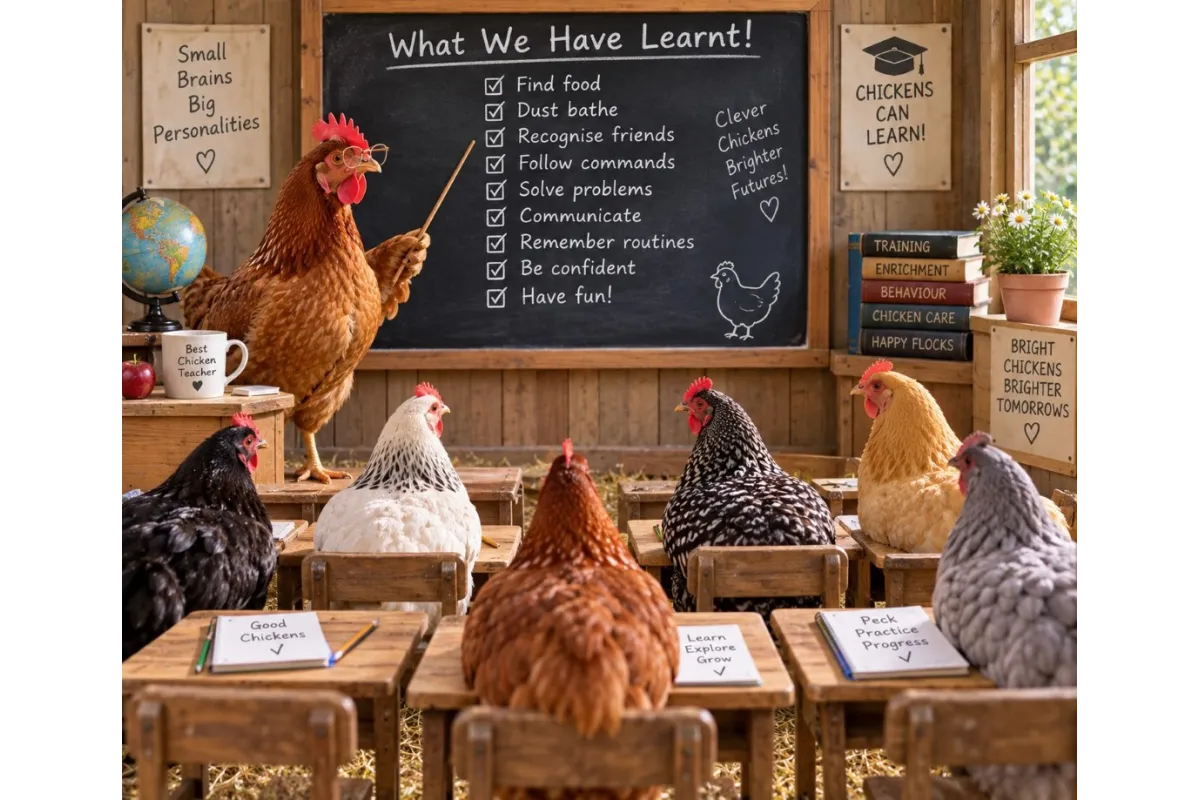
Chicken intelligence has evolved around the things chickens need to do: finding food, avoiding danger, navigating their surroundings, communicating and maintaining complex social relationships.
When we give chickens opportunities to learn, their abilities become much easier to appreciate.
Spend some time observing your own flock. Watch how quickly they learn routines, how they communicate with each other and how differently individual birds react to new situations.
Better still, introduce a clicker, target and a few favourite treats and see what happens.
You may discover that the supposedly "bird-brained" chicken watching you from across the garden has actually been watching, learning and working you out all along.