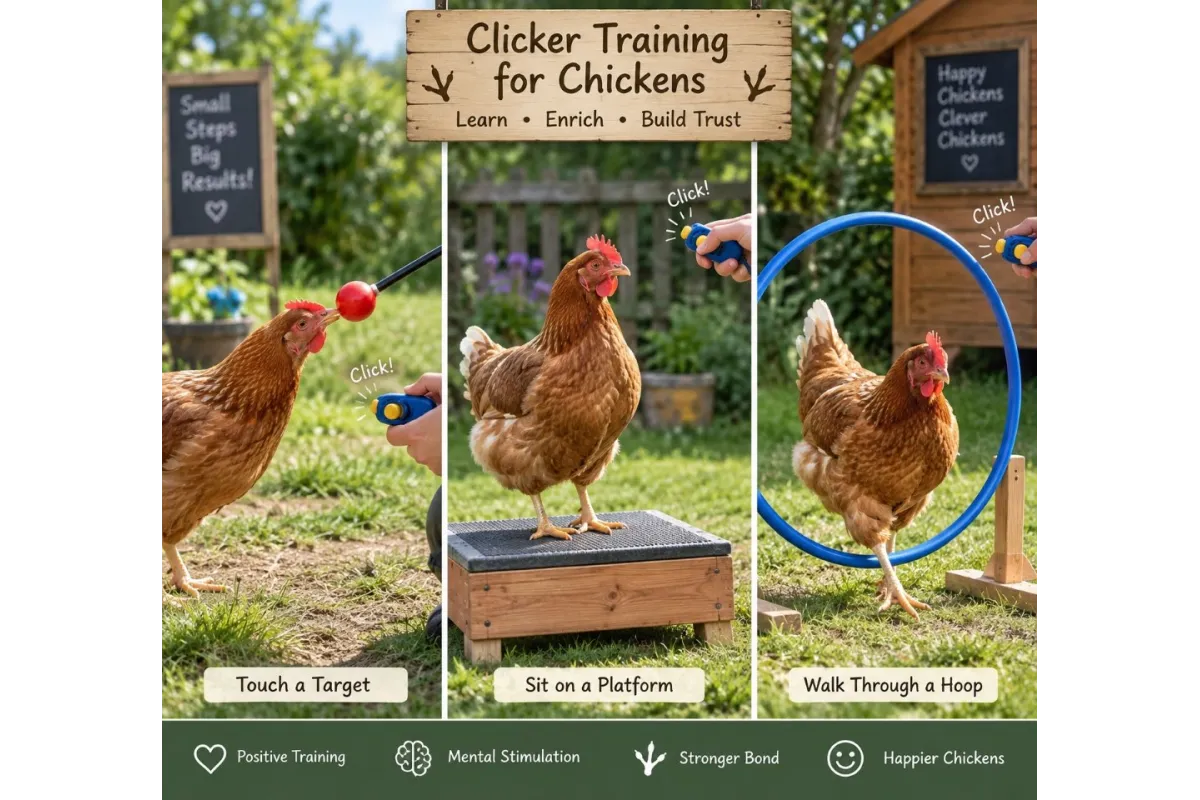
Clicker Training for Chickens: A Complete Guide with Practical Training Ideas
Clicker Training for Chickens: A Complete Guide with Practical Training Ideas
When we think about clicker training, dogs are usually the animals that immediately come to mind. You might have seen dogs being trained to sit, stay, retrieve objects or perform complicated tricks using a small handheld clicker and treats. But clicker training certainly isn't limited to dogs. Chickens can be remarkably good at it too.
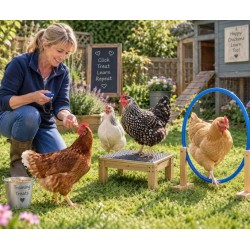
Chickens are intelligent, curious and highly motivated by food, which makes them excellent candidates for positive reinforcement training. With a little patience, chickens can learn everything from coming when called and entering their coop on command to standing on weighing scales, walking through hoops and ringing bells.
More importantly, training isn't simply about teaching entertaining tricks. Many behaviours can make everyday chicken keeping easier while providing your flock with valuable mental stimulation.
Here's how to get started.
What Is Clicker Training?
Clicker training is a type of positive reinforcement training. A small handheld clicker produces a distinctive clicking noise when pressed.
The click tells the chicken:
"Yes! That's exactly what I wanted you to do."
The chicken then receives a reward, usually a small piece of favourite food.
Timing is important because the click allows you to identify the precise behaviour that earned the reward.
Imagine you're teaching your chicken to step onto a platform. The chicken places one foot on the platform and you immediately click. The chicken knows that particular action was successful.
Eventually, the chicken begins deliberately repeating behaviours that produce the click.
First Teach Your Chicken What the Click Means
Before teaching anything complicated, your chicken needs to understand that the click predicts a reward.
Choose a relatively quiet location and have some small treats ready.
Click once and immediately offer a treat.
Wait a few seconds and repeat:
Click → treat.
Click → treat.
Click → treat.
After several repetitions, you'll probably notice your chicken reacting immediately when it hears the click. It may look towards you or expectantly search for the treat.
At this point, you're ready to start training.
Keep treats extremely small. You want to be able to provide plenty of rewards without your chicken becoming full within a couple of minutes.
Target Training: The Perfect Starting Point
Target training is one of the easiest and most useful behaviours to teach.
Choose something obvious for the chicken to touch, such as a coloured ball attached to a stick.
Hold the target near the chicken.
Chickens naturally investigate objects by looking and pecking. The moment the chicken touches the target with its beak:
Click and reward.
Repeat.
Soon, your chicken should deliberately touch the target because it understands that doing so produces a reward.
Move the target slightly farther away. When the chicken walks towards it and touches it, click again.
Once established, target training opens the door to many other exercises because you can use the target to guide your chicken almost anywhere.
1. Teaching Chickens to Come When Called
Recall is one of the most useful behaviours you can teach a free-ranging chicken.
Start only a short distance away.
Choose a consistent cue such as:
"Chickens, come!"
Give your command and encourage the chicken towards you. The moment it reaches you, click and reward.
Gradually increase the distance.
Eventually, try calling your chicken when it's scratching or exploring elsewhere.
Always make returning to you worthwhile.
Don't only use your recall command when you're about to shut the chickens away. Occasionally call them, reward them and let them return to whatever they were doing.
Otherwise, clever chickens may decide that "come" actually means "free-ranging time is over!"
2. Training Chickens to Go Back Into Their Coop
Anyone who has attempted to catch an uncooperative chicken knows how quickly a peaceful evening can turn into an unexpected workout.
Clicker training can help.
Begin by using your target to encourage the chicken towards the coop.
Initially, click and reward for approaching the coop entrance. Next, reward stepping onto the ramp. Then reward entering the doorway.
Gradually require the chicken to move farther inside before receiving its reward.
Introduce a command such as:
"Coop!"
"Bedtime!"
or
"Home!"
With regular practice, your chickens may eventually head into their enclosure when they hear the command.
3. Teaching Chickens to Stand on Weighing Scales
Regularly weighing chickens can help you monitor their general condition. However, physically placing an unwilling chicken onto scales isn't always easy.
Instead, train them to step onto the scales voluntarily.
Put the scales somewhere familiar.
Initially reward your chicken simply for approaching them.
Then progress through stages:
Looking at the scales → click.
Touching them → click.
One foot on → click.
Two feet → click.
Standing completely on the scales → click.
Once the chicken confidently stands on them, gradually delay the click by a second or two.
You're now teaching the bird to remain on the scales rather than immediately jumping off.
Eventually, introduce a verbal cue such as "Weigh."
4. Training Chickens to Enter a Pet Carrier
Pet carriers often only appear when something unusual is happening, such as a veterinary appointment. Unsurprisingly, chickens can become suspicious of them.
You can change this association.
Place the carrier somewhere safe with the door open.
Reward the chicken for approaching it.
Next, reward looking through the doorway.
Then reward putting its head inside.
Next comes one foot, two feet and eventually the entire chicken.
Never force the bird inside during training.
With enough positive experiences, your chicken may voluntarily walk into its carrier when required.
5. Training Chickens for Health Checks
Regularly checking your chickens allows you to spot potential problems with their feet, feathers, skin, comb and general body condition.
Training can make these examinations easier.
Suppose you want your chicken to become comfortable having its feet inspected.
Start by moving your hand towards its leg.
If the chicken remains calm:
Click and reward.
Next session, briefly touch the leg.
Click and reward.
Progress towards touching the foot, gently holding it and eventually lifting it.
The same technique can be used to help chickens become more comfortable with having their wings gently examined.
The key is gradual progression. Don't suddenly go from touching the chicken's back to holding it tightly and examining everything at once.
6. Teaching a Chicken to Jump Onto a Platform
Place a low, stable platform on the ground.
Reward the chicken for approaching it.
Next, reward putting one foot onto it.
Then two feet.
Finally, only click when the chicken jumps completely onto the platform.
Once the behaviour is reliable, introduce a cue such as:
"Up!"
This trick can later be adapted so your chicken jumps onto a particular perch or inspection table.
7. Teaching Chickens to Ring a Bell
Here's one that's both entertaining and mentally stimulating.
Hang a lightweight bell somewhere your chicken can easily reach it.
Initially reward the chicken for investigating the bell.
If it touches the bell:
Click immediately.
Eventually, only click when the chicken actually makes the bell ring.
Once your chicken understands the game, you may find it becomes rather enthusiastic about bell ringing!
You could introduce a command such as "Bell!" and only reward ringing after you've given the cue.
8. Teaching Chickens to Walk Through a Hoop
Start with a large hoop touching the ground.
Use your target to encourage the chicken through it.
The moment it passes completely through:
Click and reward.
Repeat several times.
Gradually remove the target and introduce a verbal command.
Once the chicken confidently walks through the hoop, you can raise it slightly off the ground.
Keep it low and safe. The objective is mental stimulation and enjoyment, not making your chicken perform enormous jumps.
9. Teaching a Chicken to Spin
Use your target to guide your chicken in a circle.
Initially, reward only a quarter turn.
Then require half a turn.
Gradually work towards a complete circle.
When your chicken understands the movement, introduce a verbal command such as:
"Spin!"
You can also introduce a hand signal.
Eventually, remove the target and see whether your chicken can perform a complete circle from the command alone.
10. Teaching Chickens Their Names
Individual chickens can potentially learn that a particular sound or word applies to them.
Begin with one chicken away from the rest of the flock.
Say its name.
When it looks towards you:
Click and reward.
Repeat this regularly.
Next, wait until the chicken is slightly distracted before saying its name.
Reward it for turning towards you.
Eventually, you can combine name recognition with recall:
"Mabel, come!"
This can be particularly useful when you want one particular bird rather than the entire flock.
11. Teaching Chickens to Move Into Different Pens
If you keep multiple groups of chickens, training birds to move into particular areas can make management much easier.
For example, you might temporarily need one hen inside a separate enclosure.
Use target training to teach the chicken to follow you into that area.
Reward heavily when it reaches the correct pen.
You can eventually introduce different verbal commands for different areas.
This can be far less stressful than chasing and catching birds.
12. Teaching Chickens to Use a Chicken Door
Young or newly introduced chickens sometimes need encouragement to use ramps or automatic chicken doors.
Clicker training can help build their confidence.
Reward approaching the ramp, stepping onto it, moving upwards and eventually passing through the doorway.
You can reverse the exercise when teaching them to come outside.
Once they understand the route, rewards can gradually be reduced.
13. Training Chickens to Accept Being Picked Up
Some chickens naturally enjoy human interaction while others are considerably more cautious.
Rather than chasing and grabbing a nervous bird, you can gradually teach it that being handled isn't something to fear.
Begin by rewarding the chicken for standing calmly next to you.
Progress to touching its body, gently placing your hands around it and eventually lifting it very slightly.
Immediately put the chicken down and reward calm behaviour.
Over time, increase the duration.
Always support a chicken properly when lifting it and never restrain it unnecessarily during a training exercise.
14. Teach Chickens to Go to a Particular Spot
"Stationing" means teaching an animal to stand in a particular place.
Put down a distinctive mat, board or platform.
Reward the chicken for approaching it, then stepping onto it and eventually remaining there.
Add a command such as:
"Place!"
This can be surprisingly practical.
For example, you could ask one chicken to stand on its station while you inspect another bird or prepare something inside the run.
15. Chicken Agility Courses
Once your chicken understands targeting and several basic commands, you can create a simple chicken agility course.
It could include:
-
Walking through a hoop.
-
Stepping over a low pole.
-
Walking along a wide, low board.
-
Jumping onto a platform.
-
Walking around a cone.
-
Following a target through a short tunnel.
-
Ringing a bell at the finish.
Keep everything low, stable and appropriate for chickens.
You're not trying to create an Olympic chicken! The purpose is enrichment, exercise and interaction.
Keep Training Sessions Short and Enjoyable
You don't need to spend half an hour training your chickens.
In fact, three to five minutes can be enough.
Short sessions help maintain enthusiasm and reduce frustration.
Initially, it can also be easier to train chickens individually. Trying to clicker train one hen while six others are attempting to steal the treats can quickly descend into chaos.
As your birds become more experienced, you can introduce training around other flock members.
Timing Makes All the Difference
Your click needs to happen at precisely the right moment.
Think of the clicker as a camera taking a photograph of the behaviour you want.
If you're teaching a chicken to step onto a platform, click the instant both feet reach it—not several seconds later when the chicken has already jumped off.
The reward can follow shortly afterwards because the click has already identified the successful behaviour.
Don't Punish Mistakes
Clicker training should remain positive.
If your chicken performs the wrong behaviour, simply don't click.
Give it another opportunity.
If the chicken repeatedly fails, you've probably made the task too difficult too quickly.
Go back one stage and reward an easier behaviour.
For example, if your chicken won't walk completely into a carrier, start rewarding it for simply approaching the entrance again.
Small successes eventually build into complicated behaviours.
Every Chicken Learns Differently
Just like people, dogs and other animals, individual chickens have different personalities.
One hen might confidently investigate your target within seconds while another watches suspiciously from several feet away.
That's perfectly normal.
Allow each bird to progress at its own speed.
Food motivation also varies. Experiment with several chicken-safe treats until you discover something your bird particularly enjoys.
The better the reward, the more enthusiastic your trainee is likely to become.
Clicker Training Is More Than Teaching Tricks
Teaching a chicken to ring a bell or walk through a hoop might sound like nothing more than entertainment, but training can provide valuable enrichment.
Chickens naturally spend their days investigating their surroundings, scratching, pecking, searching for food and responding to changes within their environment.
Training gives them another opportunity to think, investigate and solve problems.
At the same time, practical behaviours such as recall, entering the coop, stepping onto scales, accepting handling and voluntarily entering a carrier can make everyday chicken keeping considerably easier.
Start with something simple. Teach your chicken that a click means a reward and then progress to touching a target.
Once your chicken understands the basic idea, you'll probably discover that there are dozens of behaviours you can teach.
Most importantly, keep training positive, short and enjoyable.
With patience, consistency and plenty of tiny rewards, clicker training can reveal something experienced chicken keepers have known for a long time:
Chickens are much cleverer than many people give them credit for.